Painter's Folly: A Narrative History
Updated: 4 days ago
Written by Emma Leuschner for the Painter's Folly Preservation Alliance.

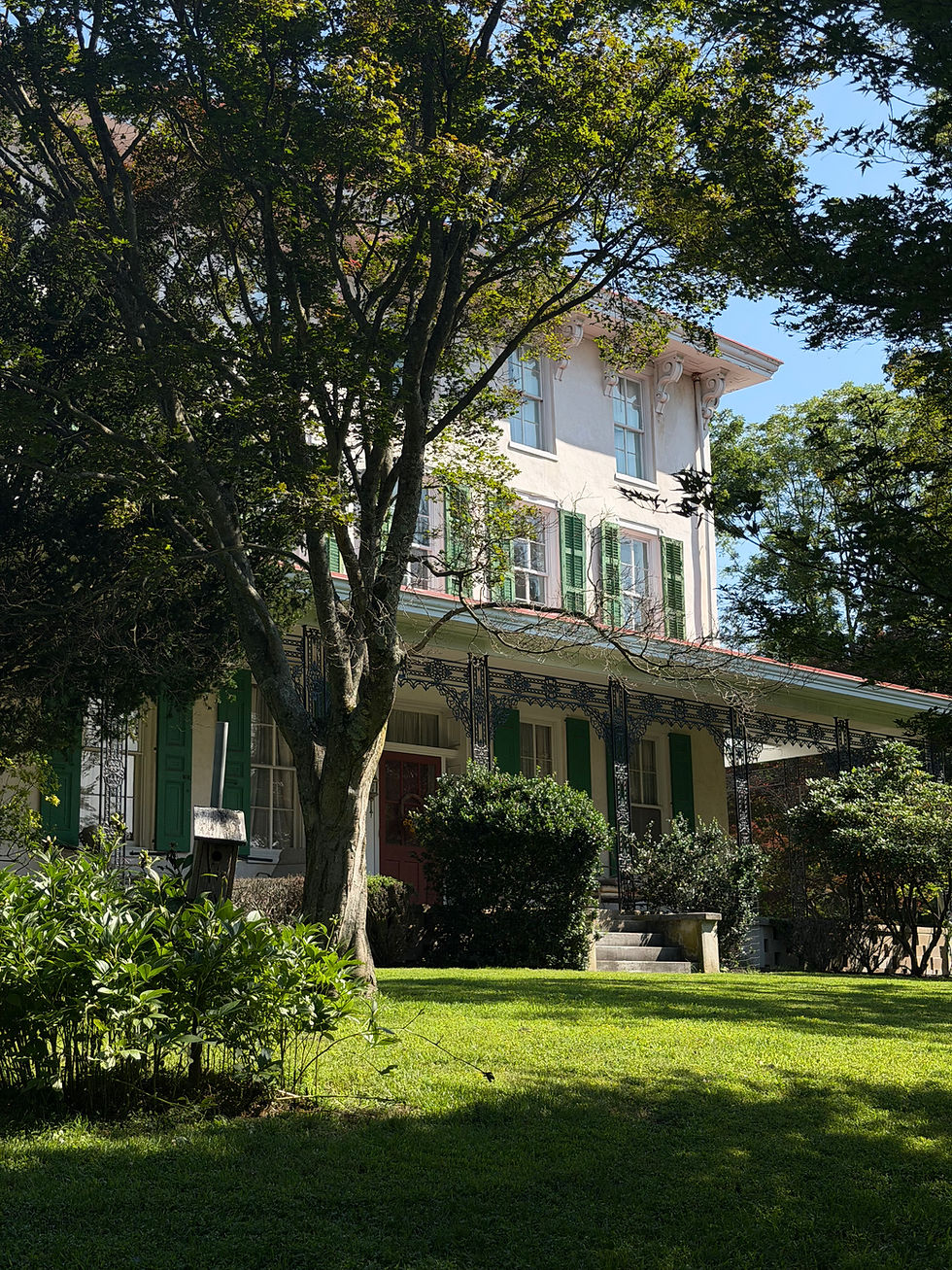
High atop a hill overlooking one of the oldest roads leading to Philadelphia stands the striking white Italianate mansion known as “Painter’s Folly.” The c. 1856-1857 building is a three-story manse complete with a towering cupola, sprawling piazzas, and distinctive green shutters. Inside, the rooms are quiet, the halls empty, but the air is heavy with history. Painter’s Folly embodies nearly 170 years of memories, conveying our nation's enduring spirit. Much like ripples in the Brandywine, these impressions flow into one another, representing the ongoing story of American identity.
Old places withstand the test of time; they serve as memorials to our stories and lives. While they may not last forever, they act as physical reminders that life existed before us and will continue long after. Thompson Mayes, Chief Legal Officer for the National Trust for Historic Preservation, writes, “In a world that is constantly changing, old places provide people with a sense of being part of a continuum, which is necessary for them to be psychologically and emotionally healthy.” Well-preserved historic resources offer a community hope. They stand firm alongside gas stations, strip malls, and shiny new developments as community elders. Old places remind us of our connection to place and time. Painter’s Folly is both a continuum and a prism of Chadds Ford’s identity. Its lifespan is linked to the origins of our country, as well as to political leaders and great artistic masters.
This is the story of an old place. For the first time in the building’s history, an organization rather than an individual owns it. Chadds Ford Township now owns Painter’s Folly, but its short line of owners and inhabitants includes a disowned Quaker, a prominent Pennsylvania suffragette and philanthropist, the father of the Brandywine School of Art, a laryngologist, the Mayor of Sea Isle City, the president of the Democratic Women’s League of Delaware County, and Andrew Wyeth’s confidants and models. This is the story of Painter’s Folly.
PAINTER’S FOLLY ORIGINS: 1856-1870
Painter’s Folly was built circa 1856-1857 for Samuel H. Painter, a birthright Quaker farmer with a penchant for architectural flair. Before the big house was built, Samuel purchased land consisting of over 200 acres from his father, William Painter, on May 26, 1845. William Painter previously purchased “a messuage and plantation containing 231 acres and two perches” in 1828 from the Gideon Gilpin estate. The land was hallowed ground associated with the Battle of the Brandywine of the American Revolution. Samuel’s 1845 land purchase also included the Gideon Gilpin House. This early Quaker homestead housed the Marquis de Lafayette before the Battle of the Brandywine in September 1777 and is colloquially known as “Lafayette’s Headquarters."
Samuel Painter was a successful, wealthy farmer by the time he built Painter’s Folly. In 1850, his farm was among the most valuable in Birmingham Township. Painter’s Folly was built as a three-story, stucco-over-stone T-shaped house with a “shallow hip roof, a rectangular rooftop belvedere, and a first-floor wrap-around porch” typical of Italianate style homes. The interior of Painter’s Folly reflected Italianate-style sentiments with its “high, molded plaster ceilings and carved woodwork.” As a Chadds Ford architectural eccentricity, Painter's Folly stood in stark contrast to the surrounding Quaker stone farmhouses. Painter’s Folly certainly did not fall in line with Quaker simplicity values, and curiously enough, Samuel Painter was disowned by the Quaker meeting on October 27th, 1848, nearly a decade before the home’s completion. The name “Painter’s Folly” itself suggests how the community perceived the house: as decorative, extravagant, and eccentric. The term “folly” derives from the French word “folie,” meaning “foolishness” or “madness.”
Local craftsmen completed the unusual country mansion by 1857 for Samuel’s small family of three, but the Painters did not stay in the house for long. By his late 50s, Samuel retired from farming, and he and his wife, Mary Hoopes Painter, moved down the road to Concordville to live with his younger brother, Darwin Painter. Samuel posted sales ads in the local papers in 1868 advertising the property as 225 acres of suitable land for grazing or dairy farming. Samuel Painter sold Painter’s Folly to Joseph C. Turner on April 1, 1870. Samuel Painter passed away only six years after he sold Painter’s Folly and was laid to eternal rest in the Concord Friends Meeting graveyard in Concord Township.

THE TURNERS: 1870-1903
Joseph C. Turner, an Episcopalian attorney residing in Philadelphia, managed a dairy operation known as Lafayette Farms and a grist mill on his land. Turner spent each summer from May to October at a nearby country estate known as Windtryst. Turner and his wife, Eliza L. Sproat Turner, were avid supporters of the arts and freedom of expression. While Joseph came to the countryside to find a quiet life as a farmer and retailer, his wife was never destined for simplicity. Eliza L. Sproat Turner was a published author, women’s club founder, and influential suffragette and abolitionist.
Although the Turners maintained a townhome in Philadelphia and Eliza was involved in many of her city-based organizations, she saw a profound opportunity for underprivileged Philadelphia children to leave the city and experience country life. By 1875, Eliza asked her rural neighbors in Chester and Delaware Counties to help host impoverished city children for a week during the summer, giving them “a glimpse of nature and a breath of the pure air of heaven.” Eliza’s neighbors gladly welcomed the first twelve children, and soon enough, children were pouring in from the Baltimore Central Railroad at no cost to experience “sunshine, fresh air, and wholesome food” for a week. This led to the founding of the Children’s Country Week Association. The organization grew rapidly over the following decades, helping more than 2,000 children by the 1920s. This vital charity began with Mrs. Eliza L. Sproat Turner’s love of the country, rooted in her summer home in Chadds Ford.
In addition to philanthropy, Eliza L. Sproat Turner helped found the Pennsylvania Woman’s Suffrage Association in 1869 and served as its Treasurer and Vice President. She established the New Century for Women newspaper and, in 1877, founded the New Century Club, which led to the formation of the New Century Guild for Working Women in 1882. The New Century Club was one of the first women’s clubs in the United States and was a hub for the promotion of “science, literature, and art.” It was supported and managed in part by the Drexel Institute beginning in 1892, which was also the employer of Painter’s Folly’s forthcoming resident, the artist Howard Pyle. It was a natural decision when Joseph and Eliza Turner leased Painter’s Folly to Samuel Painter’s nephew, Howard Pyle, beginning in the summer of 1898.

HOWARD PYLE AND THE BRANDYWINE SCHOOL OF ART: 1898-1903
Howard Pyle was a renowned American painter, author, and teacher, and is often regarded as the father of American illustration. While a native of Wilmington, Delaware, Pyle was captivated by the bucolic landscapes of Chadds Ford and the land rich with America’s Revolutionary history. Howard Pyle was Samuel Painter's nephew and the original owner of Painter's Folly. Howard was the director of the School of Illustration at the Drexel Institute in Philadelphia, and selected Chadds Ford as the site of a competitive summer school for the Institute’s top students. Pyle oversaw the Drexel Institute’s Summer School of Illustration out of Painter’s Folly and surrounding buildings from 1898 to 1900, teaching 10 to 15 of Drexel’s best students. Drexel offered 10 scholarships to students studying illustration, drawing, and painting, covering tuition and board in Chadds Ford. Applicants were required to study with Pyle for two years before the summer course, and a jury of Drexel Institute faculty members judged their applications. Students of Pyle’s Chadds Ford summer art program, either through the Drexel Institute or Howard Pyle School of Art, included renowned artists Stanley Massey Arthurs, Clifford Ashley, Arthur Ernst Becher, Anna Whelan Betts, Bertha Corson Day Bates, Clyde Osmer DeLand, Angel De Cora, George Matthews Harding, Gordon McCouch, Emlen McConnell, Thornton Oakley, Henry Jarvis Peck, Frank Earle Schoonover, Ellen Bernard Thompson Pyle, Harry Everett Townsend, Allan Tupper True, Sarah Stilwell Weber, and Newell Convers Wyeth.

Howard Pyle, his wife Anne Poole Pyle, and their many children set up their home base at Painter’s Folly beginning in May, while Pyle operated his summer program for ten weeks from June through September. Newell Convers Wyeth biographer David Michaelis describes Howard Pyle’s connection to Painter’s Folly and the building itself in his book:
“Howard Pyle’s mother had been born in nearby Painter’s Crossroads; she was a Painter, one of the area’s oldest Quaker families. During the hot summer months in Chadds Ford, Howard and his family still occupied the old Painter place, which the townspeople called Painter’s Folly. It was a massive Italianate house with a cupola, deep piazzas, a broad lawn overlooking the village, and a tennis court.”

The initial summer of 1898 proved to be a whirlwind of excitement for the citizens of Chadds Ford. Local newspapers reported on the influx of Philadelphia’s top art students to the country village and the strange goings-on of the artists at work. Papers were quick to note the connection between Pyle’s summer art school and the famed Revolutionary battle:
“The famous author-artist is occupying the old Painter homestead, right in the heart of this picturesque country, savoring of historic deeds – a country of shady roads, rich, rolling meadows, old broken down stone walls, overgrown with briars and moss, pierced by jagged crevices, through which the sun shines and the rain drives, where probably some revolutionary bullets flew over a century ago, and where brave men fell in the cause of freedom.”
Pyle had a particular affinity for history and a profound reverence for the American Revolution. Pyle was regarded in the press as having an eye for Colonial and Revolutionary “manners, costumes, house furnishings, [and] the accouterments of war.”His students followed suit. In 1899, the Philadelphia Inquirer reported that Pyle’s students were busy illustrating scenes and themes from the American Revolution. Students often dressed in historic and colonial garb while posing for one another on the lawn of Painter’s Folly, sparking the interest of Chadds Ford villagers. Many students, such as Robert L. Mason and Stanley M. Arthurs, created colonial illustrations and paintings while studying in Chadds Ford. Jill and Robert May, Howard Pyle biographers, noted the importance of time and place to Pyle’s art students in Chadds Ford:
“The picturesque nature of the Chadds Ford vicinity and memories of the important historical events that had occurred there simultaneously fostered the students’ mastery of landscape art and appreciation of their country’s past history, an important element in many of their subsequent published illustrations.”

Painter’s Folly sat firm on the same land where Americans and British fought and died, with Howard Pyle looking out over the veranda 120 years later at the meadows and valley with inspiration twinkling in his eye. Howard Pyle’s female students boarded in the neighboring Gideon Gilpin House, where the Marquis de Lafayette reportedly plotted for his first battle of the American Revolution. Pyle’s male students slumbered in the nearby General Washington’s Headquarters. As Thompson Mayes masterfully points out in his book, “connection to these old places makes them aware that they are part of the continuum, connected to people of the past, the present, and hopefully, the future.” Pyle and his summer school students certainly felt the connection to these old places and the continuum. The artists created works that depicted moments in time long before their lifetimes and were meant to endure long after. Painter’s Folly was witness to it all.
Howard Pyle painted one of his most profound revolutionary-inspired works while living at Painter’s Folly in the summer of 1902. The Nation Makers (1902) is an oil painting depicting American forces marching into battle at the Battle of the Brandywine. Pyle considered this work one of his most important in his catalog raisonné and later dispatched it on tour to cities such as New York, Chicago, and Detroit before Collier’s Weekly purchased the copyright to print it as the frontispiece of the June 1906 issue. The Nation Makers was a direct response to Pyle living on the very land where the pivotal battle took place.
Howard Pyle completed many other works while conducting his summer courses, many of which were likely worked on while living at Painter’s Folly. Pyle’s illustration subjects ranged from pirates and colonial and revolutionary scenes to medieval, mystical, and allegorical subjects, fables and fairy tales, and frontier and Native American landscapes. Noteworthy illustrations from this period include Story of the Revolution (1898), Dead Men Tell No Tales (1899), Last Years of Washington’s Life (1899), Captain Scarfield (1900), The Flying Dutchman (1900), The Pilgrimage of Truth (1900), Colonies and Nation (1901), Don Quixote (1901), The First Self-Made American (1902), and Travels of the Soul (1902).
These illustrations were published in books and periodicals, including Century, Collier’s, Everybody’s, Harper’s Magazine, Harper’s Weekly, Ladies’ Home Journal, and Scribner’s.
In addition to housing the Pyle family, Painter’s Folly was the site of critical student discussions regarding artistic expression. N.C. Wyeth biographer David Michaelis notes, “In summer, the Pyles hosted lunches and suppers and games on the shaded verandas. It was a world of sons. Mr. Pyle liked nothing better than to gather his students on the front piazza for touch, ennobling talks about life and art.” Painter’s Folly was a gathering place where Pyle’s students could interact with their leader in an intimate, informal setting outside the studio. It allowed the students to engage with Pyle as both an artist and an individual in the comfort of his summer home, amongst his family.

Pyle left the Drexel Institute in early 1900 to establish his art school, which became known as the Howard Pyle School of Art and later as the Brandywine School. Many students who had attended Pyle’s Drexel Institute classes followed him into his new endeavor. Arguably, Pyle’s most famous student, Newell Convers Wyeth, applied to the Howard Pyle School of Art in 1902 after boarding in Wilmington and attending Pyle’s Saturday night composition lectures in Chadds Ford.
Newell Convers Wyeth and the Wyeth Family
Newell Convers Wyeth, also known as N.C., was born and raised in Needham, Massachusetts. By October 1902, Wyeth, then 20, left home to study illustration and painting with Howard Pyle. Wyeth was a seamless addition to Pyle’s elite group of students and quickly became one of Pyle’s favorites. N.C. Wyeth biographer David Michaelis notes:
“Wyeth fit naturally among the Pyles. The family was an idealized version of his own, and when he first approached Painter’s Folly that early November weekend, one of the high piazza windows framed a domestic scene that would serve as a model in years ahead.”
Wyeth settled permanently along the Brandywine in Chadds Ford, Pennsylvania, in 1908, and developed into one of America’s best illustrators. His work was featured on the front page of magazines such as The Saturday Evening Post and Scribner’s, in advertisements for Coca-Cola and Lucky Strike, and, famously, in illustrations for classic literature such as Treasure Island, Robin Hood, The Last of the Mohicans, and Robinson Crusoe.
The Wyeth Family connection and legacy in Chadds Ford flourished under Newell Convers Wyeth, who deeply loved the Brandywine Valley. Newell and his wife, Carolyn Brenneman Bockius Wyeth, had five children: Henriette Wyeth Hurd, Carolyn Wyeth, Nathaniel C. Wyeth, Ann Wyeth McCoy, and Andrew Wyeth. Andrew emerged as one of the leading American painters of the mid- to late 20th century. Henriette and Carolyn also pursued careers in painting, while Ann combined her talents in both visual art and music, becoming a painter and composer. Their brother Nathaniel took a different path, becoming an engineer at DuPont, where he helped develop the plastic soda bottle.
Nathaniel married Howard Pyle’s niece, Caroline Pyle. Henriette and Ann each married one of their father’s protégés—Peter Hurd and John W. McCoy, respectively. N.C. Wyeth’s legacy continued through his grandchildren, including artists Jamie Wyeth and Michael Hurd, as well as musician Howard Wyeth. The Wyeth family legacy is fixed in Chadds Ford and stems in part from Pyle’s famous summer art courses in the village.
Howard Pyle continued living at Painter’s Folly through 1903 while teaching his summer classes. Pyle eventually grew tired of Chadds Ford and returned home to Wilmington in 1903, abandoning Painter’s Folly as a summer retreat. A public sale of Pyle’s discarded, unwanted belongings was held in June 1904. Joseph and Eliza Turner passed away in 1902 and 1903, respectively, and Dr. Arthur Horton Cleveland, Sr., bought the home from their estate.
THE CLEVELANDS AND ATWATERS: 1903-1953
New life and a new chapter began for Painter’s Folly, now known as Lafayette’s Manor or Lafayette Hall. Dr. Arthur Horton Cleveland Sr., a recent widower, purchased three tracts of land in 1903, including Painter’s Folly and the surrounding buildings, including the present-day Kuerner Farm, which were still in use as the Lafayette Dairy Farm. Dr. Cleveland’s total land purchases amounted to nearly 500 acres. Dr. Cleveland was a ward of Joseph and Eliza Turner and lived with them in Chadds Ford in the late 1800s following the death of his parents. Dr. Cleveland was a laryngologist and served on staff at the Presbyterian Hospital, the Pennsylvania School for the Deaf, and the Medico-Chirurgical College. Dr. Cleveland Sr. settled into his new life in Chadds Ford and later became president of the Birmingham Township Board of Supervisors.
Alongside his father-in-law, Richard Mead Atwater, Dr. Cleveland continued to run the dairy business, which was one of only two dairies at the time that sold milk in glass bottles. Richard Mead Atwater, a native of Rhode Island and former mayor of Sea Isle City, N.J., was a glass manufacturer by trade and saw this new venture as a perfect addition. Under Cleveland-Atwater ownership, the Lafayette Dairy Farm often hired employees from the University of Pennsylvania. One of their most notable employees was Arthur Linville, who managed the farm’s orchard and later founded the nearby 350-acre Linvilla Orchards Farm, which remains operational today. The business grew to include a successful orchard program. By 1910, Lafayette Farms was selected by the State Economic Zoologist as a “Model Orchard” for State research purposes. Lafayette Farms hosted public orchard-care demonstrations and lectures, and it became well known for its peach crop.
Painter’s Folly and the surrounding land were extensive, and the Cleveland family opened the property to Dr. Cleveland’s late wife, Ethel Wyn Atwater’s family. Ethel’s father, mother, and sister, along with hired help and farmhands, moved permanently to the new family homestead by 1906. Dr. Cleveland raised two children on the property: Arthur Cleveland, Jr., and Ethelwyn Atwater Cleveland. In 1908, Dr. Cleveland sold Painter’s Folly and 47 acres to his father-in-law, Richard Mead Atwater. Atwater and his wife stayed at Painter’s Folly, then known as Lafayette’s Hall, while Dr. Cleveland’s family moved into the nearby Gideon Gilpin House after living in the Red Barn Farm, now known as Kuerner’s Farm. Dr. Cleveland’s grandson, Arthur Cleveland III, became an essential part of the artistic legacy of Painter’s Folly, especially when Andrew Wyeth captured his likeness in the 1946 portrait, Arthur Cleveland.
The senior Atwaters, like Samuel Painter, were avid Francophiles. Richard Mead Atwater and his wife, Abby Sophia Greene, resided in Paris for six years while Richard worked as a European agent for an American harvesting machine company. Back in Chadds Ford, the Atwaters hosted the French Ambassador to the United States, Jean Jules Jusserand, at Painter’s Folly in September 1915 on Brandywine Day. Dr. and Mrs. George Philip Morris, the president of the West Chester Normal School and the Chester County Historical Society, were also present for this momentous luncheon and gave a speech regarding the significance of the Battle of the Brandywine to the Ambassador and a large crowd on the hallowed grounds following the lunch. The Atwaters exchanged correspondence with Ambassador Jusserand over the years, who fondly recalled Painter’s Folly. The Atwaters’ grandson, Richard Atwater of Tarrytown, N.Y., received the French War Cross in 1917 for bravery during World War I for his service driving an ambulance when he was only sixteen years old. The teenager spent ample time traipsing through the grounds of Lafayette Hall and passing time with his grandparents before his meritorious military service.
Richard Mead Atwater, like Howard Pyle, was fascinated with the Battle of the Brandywine. He was enthusiastic regarding his ownership of General Washington’s Headquarters, also known as the Benjamin Ring House, and Lafayette’s Headquarters, also known as the Gideon Gilpin House. Locals considered him an authority on troop movements during the Battle of the Brandywine. Atwater often spoke publicly to captivated audiences about the battle's history and significance, particularly on commemorative Brandywine Day each September. Richard Mead Atwater's wife was related to General Nathaniel Green, second in command under General George Washington, and expressed a “personal interest in all that pertains to the battle, the spirit of which carried the Americans through Valley Forge and eventually won the war.”
In addition to owning Painter’s Folly, Richard Mead Atwater purchased the nearby Windtryst property in 1913, which was built and owned by previous Painter’s Folly owners Joseph C. and Eliza L. Sproat Turner. Windtryst was a serpentine stone mansion constructed c. 1868 by Joseph Turner and used as the Turner summer home. For years, Windtryst hosted lively social dances and gatherings for the young people of Chadds Ford and later operated as a boardinghouse. The artist Newell Convers Wyeth and his family rented a room in Windtryst before their house was completed in Chadds Ford. After Richard Mead Atwater poured his resources into restoring the property, Windtryst was tragically destroyed by fire on September 11th, 1914 – 137 years to the day from the Battle of the Brandywine. Newell Convers Wyeth depicted the ruins of Windtryst in his 1915 painting “And will you stay on – after last night?” Richard Mead Atwater also owned Turner’s Mill, where Howard Pyle’s students worked during the Chadds Ford summer sessions.
Richard Mead Atwater died of an asthma attack at Painter’s Folly on October 20th, 1922. The property remained in the Atwater-Cleveland family until March 1953, when the executors of the Atwater estate sold 3.6 acres of land and Painter’s Folly to John and Mary Fisher.
Cleveland-Atwater family photo, 1912. Richard Mead Atwater
ORIGINS OF THE BRANDYWINE BATTLEFIELD PARK
As early as 1922, discussions began about creating a state park at the site of the Battle of the Brandywine. Members of the American Legion of West Chester, governors of Delaware, Maryland, and Virginia, and Pennsylvania Senator Thomas Lawrence Eyre were all early supporters of creating a Brandywine Battlefield Park. Pennsylvania legislators spent years trying to develop the park but struggled to pass the necessary bills. In 1937, Senator Weldon B. Heyburn, a local from Concord Township, proposed setting aside $10,000 for the newly appointed Brandywine Battlefield Commission to acquire land for the park, and he continued to introduce related bills over the next ten years.
It was not until May 1947 that the Pennsylvania Senate authorized the purchase of 50 acres of land for $50,000, and Governor James Duff approved the Brandywine Battlefield Park Bill in July 1947. Governor Duff appointed ten men to the Brandywine Battlefield Park Commission by November 1947, which included Bart Anderson, Samuel Bunking Lewis, Martin W. Clement, Colonel Joseph Knox Fornace, Edward Hopkinson Jr., Captain J. Clark Mansfield, Frank W. Melvin, J. Truman Swing, and Lewis H. Van Dusen.
The commission had its work cut out for it, as the landowners disagreed with the state’s financial offer. The estates of Richard Mead Atwater and Dr. Arthur Cleveland, who owned both Washington’s Headquarters and Lafayette’s Headquarters, objected to the commission’s offer price. Brandywine Battlefield area landowners banded together to form the Brandywine Community Association in 1949, intending to develop the historic park independently, without relying on state financial aid or involvement. Acclaimed artist and Chadds Ford resident Andrew Wyeth served as a director of the group. Brandywine Community Association members worried the state would keep buying up the surrounding land and buildings, but that never materialized. The acreage of the Brandywine Battlefield Park remained at 50 acres. All the while, Painter’s Folly sat just over the property border, next to the Gideon Gilpin House, as a private residence.
THE FISHERS: 1953-1974
The mid-century arrival and ownership of the Fisher family marked yet another chapter in the history of Painter’s Folly, but one that echoed sentiments from past owners. A lively family of seven filled the many rooms of Painter’s Folly. At the head of the family was John M. Fisher, a DuPont Company engineer who worked first in building and construction and, later, in design engineering. Fisher was a member of the American Institute of Chemical Engineers, the National Society of Professional Engineers, and the Delaware Society of Professional Engineers. John’s professional interests led him to tinker with and develop mathematical inventions known as slide rules. Fisher pursued a patent for one of his slide rules, designed to help bartenders craft specific alcoholic drinks.
John’s wife, Mary Kay Kelley Fisher, also known as “Gerry,” was a homemaker and mother who was deeply involved in local politics. A native of West Virginia and no stranger to grand historic homes, Mary Fisher jumped feet first into Chadds Ford life. Mary served as secretary for the Brandywine Battlefield Park beginning in 1960, as president of the Democratic Women’s League of Delaware County, and as program chairwoman for the Pennsylvania Federation of Democratic Women. Mary often hosted political gatherings, luncheons, and fundraisers for her various political and charitable organizations at Painter’s Folly. Mary served as board president of Camp Sunshine in Thornbury Township, a Delaware County summer camp initiative for at-risk youth.
Mary’s involvement in the Brandywine Battlefield Park and Camp Sunshine was certainly a connecting thread to Painter’s Folly’s past. Yet, her dedication to serving in both charity and political organizations was certainly paved, in part, by Eliza L. Sproat Turner’s suffrage work. Painter’s Folly had a keen ability to attract politically active women.
The Fishers sold Painter’s Folly in August 1974 to George E. and Helen Murray Sipala. The Sipala Chapter would bring the Painter’s Folly narrative full circle.
THE SIPALAS AND ANDREW WYETH: 1974-2018
George and Helen Sipala purchased Painter’s Folly with a sincere love for antique collecting and hosting grand parties. Although the home needed repairs when they bought it, the Sipalas moved into Painter’s Folly with deep appreciation for the house's history and architecture. George and Helen had five children. Both worked in real estate and were active in the numerous social circles of Delaware and Chester counties. However, the Sipalas’ lives changed forever during a snowstorm on March 1, 1989, when Chadds Ford resident and famed American artist Andrew Wyeth entered their lives, marking the beginning of a 20-year friendship.
Andrew Wyeth
Andrew Newell Wyeth was born July 12th, 1917, in Chadds Ford, Pennsylvania, to famed illustrator Newell Convers Wyeth and Carolyn Bockius Wyeth. He was the youngest of five children and grew up roaming the woods and hills along the Brandywine River. Andrew began drawing in childhood and, by his teens, took illustration lessons with his father in his nearby studio. His brother-in-law, Peter Hurd, introduced Andrew to egg tempera, which became a focal point of Wyeth’s work.
Wyeth’s career took off in 1937 when he had his first solo exhibition in New York City at the Macbeth Gallery. Wyeth moved between watercolors and egg tempera, drawing inspiration from the landscapes and people of Chadds Ford, Pennsylvania, and Cushing, Maine, where his wife and manager, Betsy James Wyeth, hailed from. Andrew Wyeth was considered a realist painter in the American regionalist style, a modern art movement that emerged in the 1930s and 1940s and depicted scenes of rural America. Andrew, however, considered himself an abstractionist. Art historians and critics note that Wyeth used abstract expressionism “as a means of directly transmitting/channeling the raw essence of felt poetic vision through the material.”
Andrew Wyeth received numerous awards for his significant contributions to the art world. Wyeth was notably the first painter to receive the Presidential Medal of Freedom in 1963. Wyeth received the Congressional Medal of Honor in 1988 and the National Medal of Arts in 2007. Andrew was elected to several prestigious institutions, including the American Academy of Arts and Letters, the American Academy of Arts and Sciences, the American Philosophical Society, the Académie des Beaux-Arts, and the Royal Academy.
For over seventy years, Andrew Wyeth captured a place's emotion in his work. When discussing the Kuerner Farm in Chadds Ford, a place of frequent inspiration, Andrew noted the emotional connection to his subjects: “It [Kuerner Farm]just excited me, purely abstractly and purely emotionally. “Painter’s Folly held the same sway over Wyeth and was a source of inspiration to the acclaimed artist.
Andrew Wyeth’s friendship with the Sipalas
The lives of Andrew Wyeth and George and Helen Sipala merged on Wednesday, March 1st, 1989. Helen and George were stowed away inside Painter’s Folly during the first snowstorm of the winter when they noticed a man dressed in a parka down by their swimming pool and seemingly sketching their house. The Sipalas observed the man sketching the property over the following days and finally approached him, immediately recognizing him as the artist Andrew Wyeth. Their first conversation included a discussion about Painter’s Folly’s ties to Andrew’s father, N.C. Wyeth and Howard Pyle.
Helen Sipala recorded her interactions with Andrew Wyeth in a diary from 1989 to Andrew’s death in 2009. She later published a book, Beyond the Marriage Bed: My Years as a Friend, Model, and Confidante of Andrew Wyeth, in 2021, which included the diary and personal photographs. Helen’s diary entries provide an intimate glimpse into Andrew’s personality and his relationships in Chadds Ford. The Sipalas and Wyeth initially bonded over practical jokes, with humor diffusing the mystique and grandeur of Wyeth’s palpable fame. George Sipala and Andrew were well known for their comedic personalities. Helen’s early diary entries account for numerous practical jokes and pranks played between Andrew Wyeth and the Sipalas. Humor put everyone at ease, bringing comfort and a deep sense of trust among the three. Soon, George and Helen Sipala gave Andrew Wyeth access to Painter’s Folly, and Andrew came and went as he pleased.
Andrew Wyeth often retreated to Painter’s Folly to escape the press, prying neighbors, jealous models, and even his own family. While Andrew Wyeth was at home in Chadds Ford from October through May, he let himself into Painter’s Folly in the early morning hours and often climbed the three flights of stairs up to the cupola to work. Wyeth left materials, studies, and paintings in Painter’s Folly and used a bedroom on the third floor as a private studio. Soon enough, others from Wyeth’s world figured out where he was stowed away and would burst into the house to search for him.
The Sipalas began hosting grand dinner parties after Andrew Wyeth entered their home and lives. In addition to Andrew’s immediate family, an impressive cast of characters regularly filled the rooms of Painter’s Folly for Christmas parties. Notable visitors included Charles Cawley, Phyllis Diller, Anna Harnoncourt, Joseph Richel, Irene and Barbara duPont, Eugene and Cindy duPont Weymouth, Tom and Edna Hartness, the Kuerners, Gene Logsdon, Richard Meryman, Richard Sanford, Larry and Klara Silverstein, Frolic Weymouth, and the entire surviving extended Wyeth family. The Sipala-Wyeth Christmas parties became well-known and revered annual events, with attendees regularly singing Helen’s praise in follow-up thank-you letters.
Andrew Wyeth’s work depicting Painter’s Folly and Sipalas
According to the Wyeth Study Center at the Brandywine Museum of Art, there are 15 titled works that Andrew Wyeth completed while at Painter’s Folly. Outside these titled works, there are dozens of untitled watercolor and pencil studies. However, Andrew Wyeth began painting Painter’s Folly long before he met the Sipalas and used the home as a private studio. In 1967, Wyeth included the mansion in an untitled watercolor that depicts both Painter’s Folly and the Kuerner Farm from a distance. He revisited the house in 1968 in another watercolor, Toward Atwater's Study, this time from a closer distance. Twenty years later, Andrew Wyeth began a decade of steady work within the confines of Painter’s Folly, using the house as both a muse and a private studio space from October through May.
The 1989 tempera Painter’s Folly was the first of many works that Andrew Wyeth completed in this new decade of friendship, collaboration, and symbiosis with the house and its inhabitants. This painting depicts the snow-covered exterior of Painter’s Folly, encircled by the Sipalas' pool-nymph statues. The 1990 Widow’s Walk depicts the exterior façade of the Painter’s Folly cupola, a place that captivated Wyeth from both the inside and outside. Wyeth used the cupola's interior as a setting for paintings often depicting Helen, including Glass House (1991), Dovecote (1992), Traveling Alone (1992), and Renfield (1999). Helen became a Wyeth muse in her own right, posing for paintings both as herself and as a Catholic nun character wearing a traditional habit. The nun paintings include Buttercups (1992), Cape May (1992), and Cornet (1992).
Perhaps the most famous Sipala painting is Marriage (1993). The tempera shows George and Helen Sipala at home in Painter’s Folly, asleep in their bed. The painting resulted from Andrew’s close, personal relationship with the Sipalas and his often-voyeuristic approach to his models. The Sipalas provided Wyeth a key to Painter’s Folly early in their friendship, and Andrew would let himself into the home in the early hours of the weekend while George and Helen were still asleep. Marriage (1993) is a testament to their friendship, conveying the intimacy between Wyeth and the Sipalas.
Andrew Wyeth often spoke with Helen Sipala about death, legacy, and the future, and those conversations culminated in a series of pencil sketches depicting Wyeth’s funeral, known as the “Funeral Group.” After seeing a photograph of Helen Sipala’s late father lying in a casket at his funeral, Wyeth began sketching his own funeral and a close-knit cadre of attendees between 1991 and 1994 while working out of Painter’s Folly. The Funeral Group comprises several loosely drawn ensemble landscapes depicting Wyeth’s funeral at the base of Kuerner Hill and a group of mourners surrounding the casket, along with several portrait studies of the mourners, each focusing on a single model. A cataloging note from one sketch in the collection identifies the attendees: “The artist laid out in a casket with friends looking down on him. L to R: Andy Bell, Jimmy Lynch, Helga Testorf, Betsy Wyeth, Anna Kuerner, and Helen Sipala.” Helen is often depicted in the funeral series, both in pencil portraits and in broader landscapes, likely because Wyeth worked on it while at Painter’s Folly. Helen kept this collection after Andrew Wyeth's death in 2009 but gave the works to the Wyeth family in 2019.
Andrew’s contemplation on death and legacy extended to Painter’s Folly itself. According to Helen, Wyeth’s attempts to preserve Painter’s Folly were a point of pride, as he “believed Painter’s Folly belonged to the art world." Andrew’s wishes for Painter’s Folly did not end there. Helen Sipala recorded in her published diary that “he [Andrew Wyeth] was adamant Helen was to keep his works in Painter’s Folly if he died.” Andrew Wyeth’s connection to the building was comprehensive, including his family’s history with the property, Wyeth’s use of the home as a private studio, and his close friendship with George and Helen Sipala.
Andrew Wyeth’s last visit to Painter’s Folly was on Christmas Day, 2008, when he came to visit the Sipalas with Helga Testorf. The Sipalas’ final encounter with their friend was on January 3rd, 2009. Andrew Wyeth died at his studio in Chadds Ford on January 16, 2009, at the age of 91.
SALE TO CHADDS FORD TOWNSHIP: 2018-PRESENT
George and Helen Sipala sold Painter’s Folly to Chadds Ford Township on March 29th, 2018. Chadds Ford Township used Open Space funds to purchase the property for $625,000. Initially, Chadds Ford Township purchased the property to protect Painter’s Folly from developers. The property was opened for paid tours and artist studio rentals known as The Studios of Painter’s Folly: Community Art Space on the second and third floors. However, Chadd Ford Township phased out public programming because of ADA accessibility concerns. Painter’s Folly now sits quiet and closed off to the public, with its future uncertain.
The significance of Painter’s Folly lies in its role in shaping Chadds Ford’s identity. This distinctive Italianate mansion has symbolized leadership, creativity, and continuity for nearly 170 years. Thompson Mayes highlights the importance of historic places that foster creativity to the American public:
“These places of creativity draw other people who want to connect to the power of creativity. Just as people traveled on pilgrimages to visit the relics of saints, they now go to visit the places where creative people worked, dreamed, and struggled … From Mark Twain’s house in Hartford, Donald Judd’s loft building in Manhattan, Jackson Pollock’s house on Long Island, to William Faulkner’s Rowan Oak, these places attract people who want to connect with the creative power of art and artists.”
Painter’s Folly stands proudly among these places of creativity, serving not only as a reminder of Chadds Ford’s artistic heritage but also as a living testament to the enduring power of imagination rooted in place. Its preservation ensures that future generations can connect with the spirit of innovation and artistry that has long defined the community. In safeguarding Painter’s Folly, we honor the past, inspire the present, and secure a legacy of creativity that will continue to shape Chadds Ford’s identity for years to come.
Selected Sources
American Academy of Arts and Letters and National Institute of Arts and Letters. Program for the Annual Ceremonial, May 22, 1947. New York, 1947. American Foundation for the Blind.
American Academy of Arts & Sciences. "Andrew Newell Wyeth." April 11, 2025. https://www.amacad.org/person/andrew-newell-wyeth.
Baumgartner, Karen, William Coleman, and Lillian Kinney. "Re: BMA Research Center Inquiry – Painter's Folly." Email to Emma Leuschner, August 11, 2025.
Berwick Enterprise. "Members Named to Brandywine Commission." November 18, 1947, 2.
Brandywine Museum of Art. Andrew Wyeth: Home Places. Accessed August 20, 2025. https://www.brandywine.org/sites/default/files/2023-02/ANDREW%20WYETH%20HOME%20PLACES.pdf.
Brattain, Michelle. "Turner, Eliza L. Sproat (1826–1903), Poet, Suffragist, and Women's Club Leader." American National Biography. February 2000. https://www.anb.org/view/10.1093/anb/9780198606697.001.0001/anb-9780198606697-e-1501074.
Daily Republican. "Anniversary of the Battle of Brandywine." September 12, 1921, 1.
Delaware County Recorder of Deeds. Deeds for 142 Baltimore Pike, Chadds Ford, Pennsylvania. Deed Book R1, p. 463; Book W1, p. 571; Book Z2, p. 265; Book R, p. 237; Book 367, p. 620; Book 1673, p. 32. Delaware County Archives, Pennsylvania.
Dorchester, Jane E. "Painter's Folly." National Register of Historic Places Inventory–Nomination Form. US Department of the Interior, National Park Service, 2025. PA-SHARE key no. 2019RE16276.
Duff, James H. An American Vision: Three Generations of Wyeth Art. Little, Brown, 1987.
Furst, Karen Smith. Around Chadds Ford. Arcadia, 2005.
Hann, Mary Ford. "Countian Adds Nursing Class to Homemaking, Civic Duties." Delaware County Daily Times, July 3, 1963, 4.
Hopkins, Henry W. "Birmingham." In Atlas of Delaware County, Pennsylvania. 1870. Greater Philadelphia GeoHistory Network. Accessed July 25, 2025. https://www.philageohistory.org.
Kimmelman, Michael. "Andrew Wyeth, Painter, Dies at 91." New York Times, January 16, 2009.
May, Jill P., and Robert E. May. Howard Pyle: Imagining an American School of Art. University of Illinois Press, 2011.
Mayes, Thompson M. Why Old Places Matter: How Historic Places Affect Our Identity and Well-Being. Rowman & Littlefield, 2018.
Michaelis, David. N. C. Wyeth: A Biography. Perennial, 2003.
Morse, Willard S., and Gertrude Brinckle. Howard Pyle: A Record of His Illustrations and Writings. Wilmington Society of the Fine Arts, 1921. Reprint, Trieste Publishing, 2018.
Mueller, A. H. "Birmingham." Plate 54 in Atlas of Delaware County, Pennsylvania, vol. 2. 1913. DelawareCountyHistory.com.
Oliver, Gerry. "County Lines: Inventor Demonstrates Creativity." Delaware County Daily Times, February 7, 1962, 13.
Philadelphia Inquirer. "Art and Artists: The Revolutionary Pictures at the Academy—A Special Exhibition at the Drexel—Other News." May 15, 1898, 15.
Russell, Charles H. "Will Be State Park: Battle of Brandywine Lost by Colonials 171 Years Ago." Delaware County Daily Times, September 11, 1948, 1.
Shaviro, Steven. "The Life and Death of Postmodern Emotions." Criticism 46, no. 1 (2004).
Sipala, Helen Murray. Buttercups & Gratitude: My Illustrated Journey with Andrew Wyeth. Edited by Bruce Mowday. 2023.
Sipala, Helen Murray, and Bruce E. Mowday. Beyond the Marriage Bed: My Years as Friend, Model and Confidante of Andrew Wyeth. Regent Press, 2021.
Thompson, Jack B. "The Ramparts Are Stormed: 2d Battle of Brandywine On as Farmers Try to Halt Park." Delaware County Daily Times, March 9, 1949, 1–2.
Time. "Milestones." January 25, 1937.
US Census Bureau. Population schedules, Delaware County, Pennsylvania:Seventh Census of the United States, 1850. Birmingham Township. NARA microfilm M432, roll 776, p. 102b.Ninth Census of the United States, 1870. Concord Township. NARA microfilm M593, roll 1336, p. 218A.Twelfth Census of the United States, 1900. Birmingham Township, enumeration district 140. NARA microfilm T623, roll 1404, p. 4.Thirteenth Census of the United States, 1910. Birmingham Township, enumeration district 95. NARA microfilm T624, roll 1338, p. 2b.
Volpe, Christopher. "Wyeth the Abstract Expressionist." Streamline Publishing, November 15, 2024.
Wyeth, Andrew, et al. Andrew Wyeth: Life and Death. Colby College Museum of Art; DelMonico Books/D.A.P., 2022.


Comments