State of the Building
Updated: Jul 23
Understanding the current condition of Painter’s Folly is essential to documenting and preserving its historic character. The following overview outlines the building’s architectural features and existing structural conditions, providing a snapshot of its current state.
Architectural Description
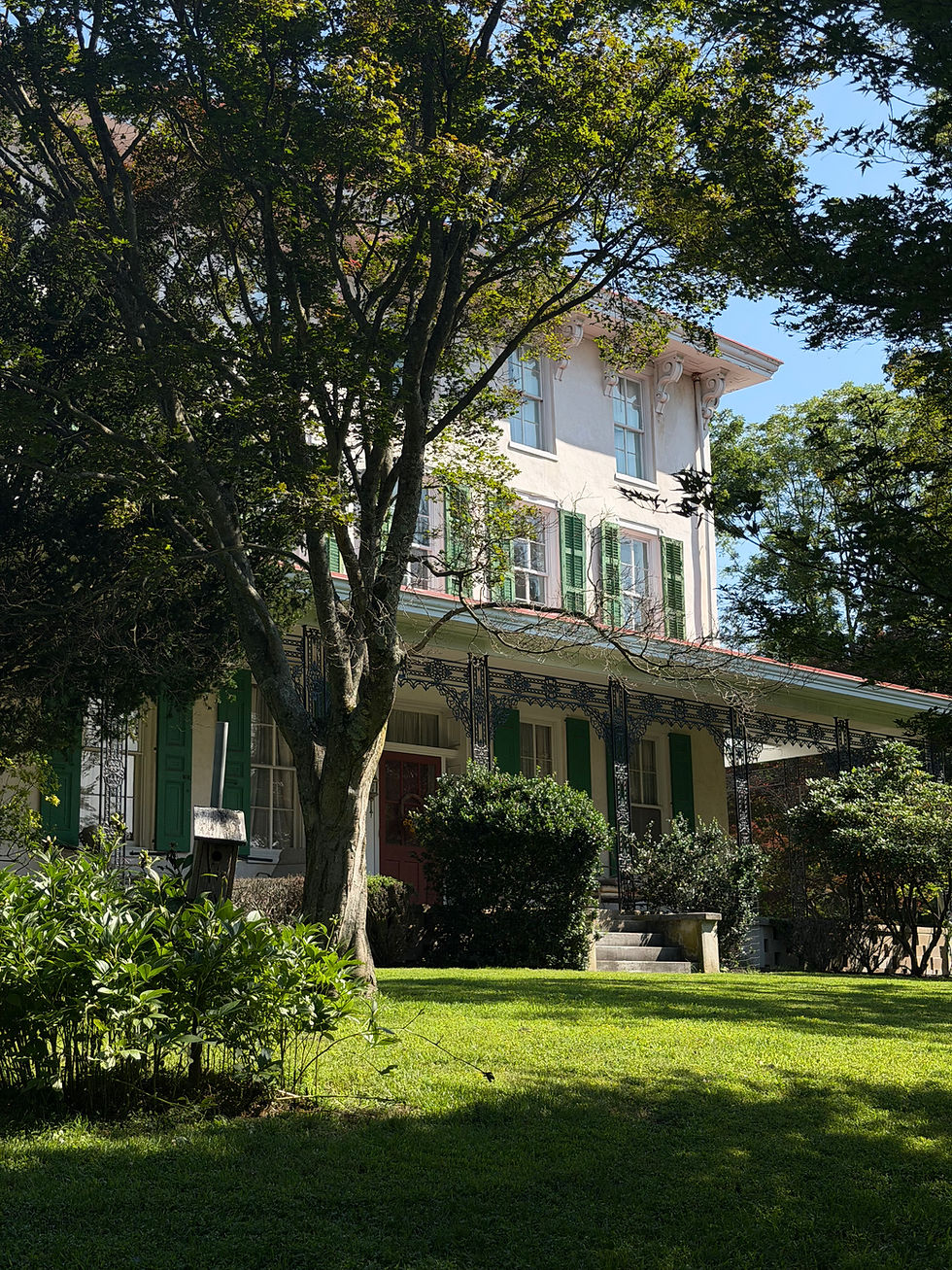
Painter’s Folly, built c. 1857, is a 6,870-square-foot, stucco-over-stone Italianate-style residence oriented toward Baltimore Pike. The house has a distinctive T-shaped plan with a three-story, five-bay main block and a two-story rear ell, built on a stone foundation with a basement. The building’s features, characteristic of the Italianate style, include a low-sloped hipped roof with wide overhanging eaves, heavy carved-wood brackets, tall, well-proportioned windows, and a central rooftop belvedere with arched sash windows. The wrap-around first-floor porch supported by stone walls and piers, with cast-iron posts and decorative elements, is a prominent exterior feature. The exterior elevations are marked by symmetrically arranged four-over-four double-hung wood windows, a combination of paneled and louvered shutters on the lower floors, multiple historic entrances, and decorative porches on the secondary elevations. Interior chimneys, standing-seam metal roofs, and finely detailed woodwork further define the building.
The interior of Painter’s Folly reflects its mid-19th-century design through a well-organized floor plan and largely intact historic finishes. The first floor of the main block contains four principal rooms arranged around a central entrance hall with a dog-leg staircase, featuring hardwood floors, plaster walls and ceilings with decorative moldings, wood trim, and marble mantelpieces. The basement follows a distinctive T-shaped circulation plan and includes multiple rooms, a root cellar, two back staircases that connect to the upper floors, and an exterior entrance. The second floor consists of four finished rooms with similar period materials and wood mantelpieces. In comparison, the third floor also contains four rooms with simpler plaster and wood finishes, built-in closets, and access to the belvedere.
Painter’s Folly is set on a 3.44-acre parcel elevated above U.S. Route 1/Baltimore Pike and is accessed by a paved driveway lined with historic stone retaining walls. Originally part of a 227-acre gentleman’s estate surrounded by rolling agricultural land, the property was gradually reduced in size during the early 20th century as farmland and outbuildings were parceled off, many of which are now incorporated into Brandywine Battlefield State Park. The south-facing mansion sits on a prominent rise, with the original stone farmhouse and barn remnants to the west. Several former agricultural structures, including barns and an ornate chicken house, no longer survive. A 20th-century swimming pool northeast of the house has been filled, leaving only partial concrete walls. The remaining carriage house, located north of the mansion, has been extensively altered for residential use. The historic stone retaining walls along the driveway remain contributing features that reflect the property’s rural historic setting, despite later changes.
Threats to Painter's Folly
In the July 31, 2025, Painter’s Folly update, Chadds Ford Township notes that there are “current and long-term maintenance and repairs needed” at Painter’s Folly. However, the specific repair and maintenance projects are unknown, and Chadd Ford Township has not made the information publicly accessible.
Chadds Ford Township has sought to address public concern about the proposed public auction of Painter's Folly by using conservation and façade easements to safeguard the property's preservation. However, the Township has not clearly defined the scope of these easements. Unresolved issues include the number of exterior elevations to be protected from alteration, the permissibility of additions or modifications to unprotected elevations, and whether any interior spaces would be subject to easement restrictions.
During the July 16, 2025, public meeting regarding Painter's Folly, Township Supervisor Kathleen Goodier indicated that the proposed façade easement would apply only to the two elevations visible from Baltimore Pike, leaving the remaining elevations potentially subject to alteration or expansion.
As currently described, the proposed conservation and façade easements do not address the building's interior spaces. This omission was raised as a concern during a September 2025 meeting between representatives of the Preservation Alliance of Greater Philadelphia and Chadds Ford Township Manager Lacey Faber.
The house's interior spaces are arguably the most critical part of the property. One of Howard Pyle's most profound, revolutionary-inspired works was painted while he lived at Painter's Folly. The Nation Makers (1902) is an oil painting depicting American forces marching into battle at the Battle of the Brandywine. In addition to housing the Pyle family, Painter's Folly was the site of critical group discussions regarding artistic expression.
Andrew Wyeth used a third-floor room and a widow's walk in Painter's Folly as a private studio and workspace where he completed 15 titled works of art and countless studies and sketches, as noted by the Wyeth Study Center. Many of Wyeth's works reflect the interior spaces of Painter's Folly, including Glass House (1991), Dovecote (1992), Traveling Alone (1992), Marriage (1993), and Renfield (1999). The architectural integrity of the interior spaces is very high, as noted in the 2024 National Register of Historic Places nomination.
In addition to the interior spaces, Painter's Folly currently retains several important antiques and artworks associated with the Sipalas and Andrew Wyeth, including a Wannamaker family grandfather clock, a marble bust of the Marquis de Lafayette given as a gift from Wyeth, hand-carved Eastlake Victorian furniture, and stone garden mermaid statues portrayed in Wyeth's Painter's Folly (1989) painting.
Alterations to these interior spaces and the removal of essential physical materials would forever dissolve their historical significance, thereby depriving us of the ability to continue studying and scholarship on both Howard Pyle's and Andrew Wyeth's creative processes and bodies of work.
Sources + Further Reading:
Dorchester, Jane E. Publication. National Register of Historic Places Inventory-Nomination Form: Painter’s Folly. United States Department of the Interior: National Park Service, 2025.


Comments